


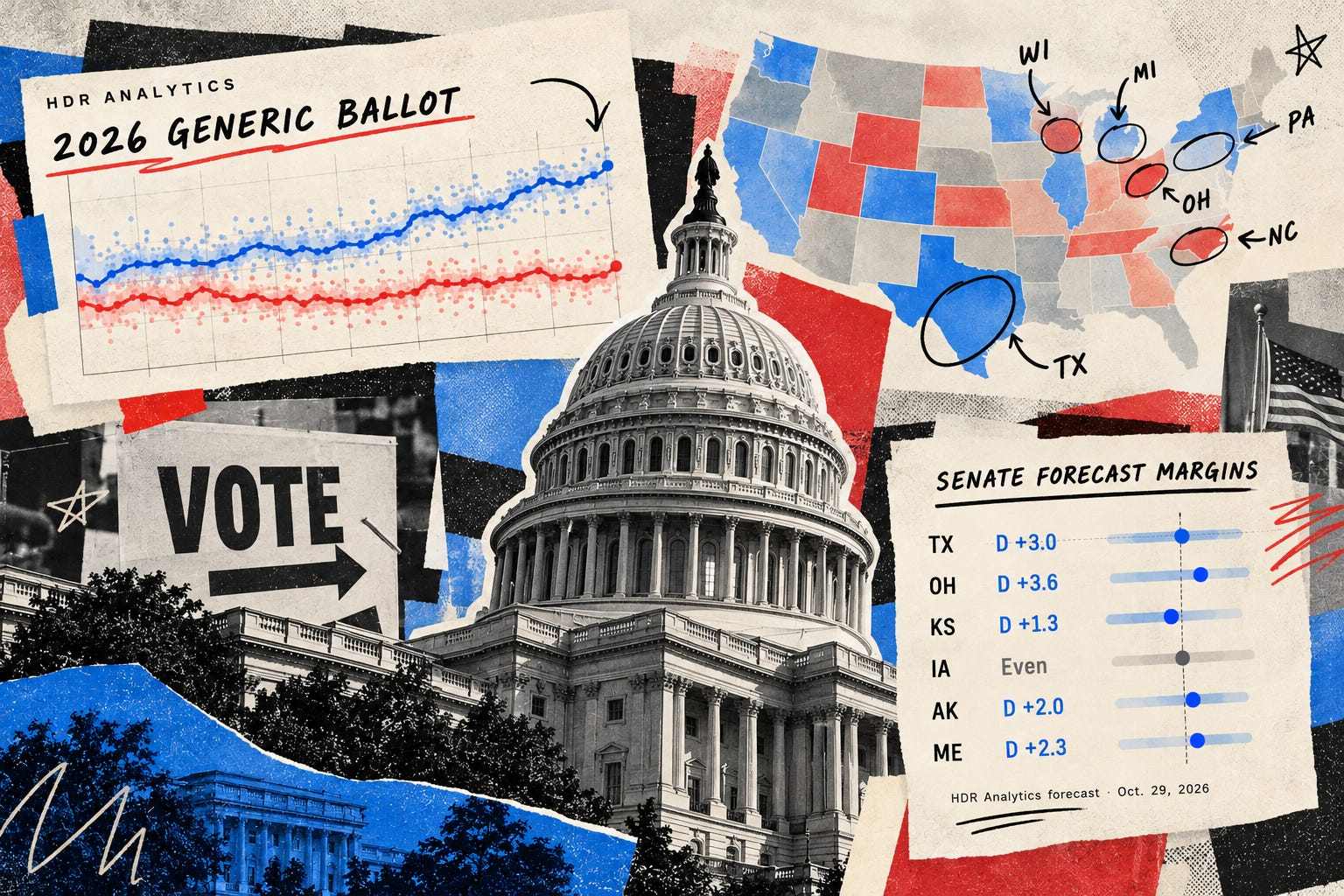
With under a week until Election Day, Democrats have to be happy with their overall position.
Our latest 2026 election forecast (new and improved!) gives them a greater than 99% chance of taking back control of the House of Representatives (I believe the House model is overstating things and isn’t as well calibrated as Senate and Governor) and a 79% chance of winning control of the Senate. The model projects Democrats to win an average of 253 House seats (only 218 are needed for a majority, again, this is a pretty high estimate) and 52.3 Senate seats (they need 51 for a majority). If that happens, it’d be the first time Democrats control both chambers of Congress since 2023.
That’s a pretty dramatic reversal from where things stood after 2024, when Donald Trump won the presidency and the GOP secured contorl of both chambers. And while the incumbent president’s party almost always loses ground during midterms, Democrats are now competitive in several states that a few years ago would’ve been considered very safe for Republicans.
Texas, Iowa, Kansas, and even Alaska all have Democratic candidates that are favored in our Senate forecast. Republicans are also defending competitive governor races in states like Iowa and Ohio, while facing the likely outcome of losing a substantial number of House seats.
To be perfectly clear, this doesn’t mean Democrats are guaranteed to win everything. The Senate in particular still has plenty of room for surprises (a 25% chance is significant) and a fairly small polling error in a few states could change the composition drastically.
So, with Tuesday quickly approaching, let’s take a look at what the data tells us, and where the biggest surprises may come from.
The national environment is pretty ugly for Republicans
Let’s start with the obvious: this is shaping up to be a very difficult election for the Republican party.
Democrats currently hold an eight-point lead in our national generic congressional ballot polling average. That’s a substantial advantage, and one that helps explain why Republicans are struggling in races outside the traditional battleground states (Democrats won the generic ballot by 8.4% in 2018). There are a lot of reasons we could point to for this. The economy has remained a major concern for voters, with inflation, housing costs, and general affordability continuing to drag down consumer confidence, partly thanks to the drawn-out Iran war. Earlier this year, our Consumer Sentiment Index fell to its lowest level in a decade, and Americans have been extremely unenthusiastic about the economy overall.
That matters politically. “It’s the economy, stupid” still seems to hold true today, and voters almost always hold the party in the White House responsible for economic conditions, justified or not. Republicans who campaigned heavily on lowering prices in 2024 and ending “Bidenomics” now face even louder questions about affordability.
There’s also the historical context. Midterm elections are usually unfriendly to the incumbent party, with Republicans losing 40 House seats in 2018 and Democrats losing 63 in 2010. The only recent exception was 2022, when Democrats performed far better than expected despite Biden’s low approval ratings. But even then, Republicans narrowly flipped House control.
This year, polling suggests the backlash could be much larger. That doesn’t mean every Republican candidate is doomed, but it does mean they are fighting an uphill battle in races that would otherwise be comfortable.
The House is almost certainly flipping
Of the two chambers of Congress, the House is the much easier one to forecast right now. Our model gives Democrats a greater than 99% chance of winning a majority, although I think that is overconfident. The House model was thrown together at the last minute and I have less faith in it than I do the Senate and Governor forecasts, but most other models have Democrats at above a 90% chance, so it’s a pretty small distinction.
That topline probability doesn’t mean every individual district is easy to predict. In fact, several races are effectively coin flips. PA-1 and ME-2 are both at 50-50 in our forecast, and WI-1 has Republicans at just a narrow 53% chance of holding the seat.
Here’s the problem for the GOP: they can win quite a few of these close races and still lose their majority. To actually keep the House, they’d need to outperform expectations in a substantial number of districts across the country, which could technically happen, but would require an enormous polling miss.
The Senate is where things get interesting
The Senate is a much different story. Republicans enter the 2026 cycle with a 53-47 majority and the vice presidency, meaning Democrats need to flip four Republican-held seats and maintain their own to win control. After 2024, that seemed extremely difficult. And to be fair, it still is. But the national environment has made several Republican seats surprisingly competitive, giving Democrats far more paths to a majority than before.
Our latest forecast gives Democrats a 76% chance of controlling the Senate, compared to a 21% chance for Republicans and 3% for neither party1. Democrats are projected to win an average of 52.2 seats.
These numbers have improved significantly over the last few months. On August 21st, when our forecast launched, Democrats had a 60% chance of Senate control. That has since climbed, even as Election Day has gotten closer and the amount of remaining uncertainty has decreased.
North Carolina is the strongest Democratic pickup opportunity, with our model giving current governor Roy Cooper a >99% chance of victory. Ohio also looks favorable for former Senator Sherrod Brown, who has an 85% chance of winning.
But beyond those two states, things are considerably more competitive. In Maine, Democrats are favored to finally unseat Susan Collins with a 56% chance of (new) Democratic nominee Troy Jackson flipping the seat. In Kansas (yes, we are in Kansas anymore?), our polling average has Democrat Adam Hamilton leading Senator Roger Marshall by 2.1%, with a 73% chance of victory.
Then there’s Iowa, where Democrat Josh Turek is effectively tied with Republican Rep. Ashley Hinson, as he has a 52% chance of flipping that seat. Nebraska is similarly intriguing, but with a different setup. Independent Dan Osborn is making his second attempt at a Republican seat in the cornhusker state, and has a 51% chance of winning.
These races are important because Democrats don’t need to win all of them to secure a majority. But losing too many would make their path considerably more difficult, particularly if Republicans manage to pull off an upset in a Democratic-held seat.
And there’s one state I haven’t mentioned yet that could change the entire picture.
Can Blexas become a reality this time? (again)
Back in May, I wrote about how Republicans nominating state attorney general Ken Paxton could give Democrats their best chance of winning a statewide election in Texas in years. GOP primary voters did indeed choose Paxton over incumbent Senator John Cornyn, and it’s impossible to say that hasn’t helped Democratic nominee James Talarico.
Those who have followed elections for a while now can remember that Democrats have thought Texas would be a pickup for several cycles now, only to fall short time and time again whether it be Biden, Beto O’Rourke, etc. But Paxton’s (almost impressive) resumé of scandals has been such a hit to his chances that Talarico is a clear favorite with an 80% chance of flipping the seat. However, Talarico is only ahead in the polling average by three points, and a pretty typical polling error can easily cause disappointment for Democrats yet again.

Don’t forget about the governors
While most people are focused on the House and Senate (rightfully so), there are also 36 governor races this year, many of which could be flips. Our forecast currently favors Democrats to flip governorships in Alaska, Iowa, Ohio, and Nevada, while Republicans are favored to flip Kansas.
Iowa is particularly interesting. Democrats have a 96% chance of winning the governorship in our model, with a projected margin of 6.4 points. That’s a pretty dramatic shift in a state that voted for Trump by about 13 points in 2024.
Ohio is also looking promising for Democrat Amy Acton against Vivek Ramaswamy, with an 80% chance of winning and a projected three-point margin.
Nevada is a much closer race. Democrat Aaron Ford has a 65% chance of defeating Republican incumbent Joe Lombardo, with our polling average giving Ford a relatively small 0.6-point lead.
And then there’s Wisconsin. After months of a crowded and extremely chaotic Democratic primary, the race to succeed retiring Gov. Tony Evers is projected to be a five-point Democratic victory, which would allow the party to retain the governorship heading into the 2028 presidential election. That is especially important, as Wisconsin is one of the most competitive states in the country, and the next governor will play a significant role in determining its political direction over the next four years.
How much confidence can we have in the polls?
One of the things I always try to emphasize with forecasts is that a probability is not a prediction that something will definitely happen.
If a candidate has a 75% chance of winning, that doesn’t mean the model expects them to receive 75% of the vote. It means they win in roughly three out of every four simulations. The other one out of four matters too, and can happen.
Our model uses a combination of polling averages and electoral fundamentals, accounting for uncertainty in the polls, the possibility of late movement, and the fact that polling errors often affect multiple states at once.
That last part is especially important in the Senate. If Republicans are being underestimated nationally, it’s unlikely that the error would affect only Texas, for example. It could also shift close races in Maine, Alaska, Kansas, and Iowa, potentially changing several outcomes at the same time.
That’s why a 76% chance of Senate control is certainly favorable for Democrats, but far from a guarantee. Republicans still have a realistic path to holding the chamber, even if that path has narrowed substantially since the forecast launched.
The House is a different situation. An upset there would require something far larger than a typical polling error, which is why our forecast gives Democrats such overwhelming odds of winning.
What I’m watching early on Election Night
North Carolina and Ohio will be important early indicators for the Senate. Democrats are heavily favored in both, so unexpected Republican strength would be a pretty concerning sign for their chances elsewhere.
Texas is probably the race I’m most interested in overall. A Talarico victory would be a huge political upset historically, even if our current model considers him the favorite. It could also make the math for a Democratic Senate majority considerably easier.
Florida has a seemingly competitive governor race and a less competitive Senate race, but counts votes quite fast compared to the rest of the country, so we should get some good results early in the Sunshine State.
Maine, Alaska, Iowa, and Kansas are all close enough that neither party should feel particularly comfortable. If Democrats are winning most of these races, they’re probably having a very good night. If Republicans are winning them, Senate control could come down to the wire.
And in the House, I’ll be watching not just whether Democrats win, but how many seats they actually pick up. There is a pretty significant difference between a narrow majority and something approaching the 253 seats our model currently expects, which is probably aggressive.
The bottom line
At this point, Democrats are clearly favored to win the 2026 midterms. Our forecast gives them overwhelming odds in the House and a fairly substantial advantage in the Senate, with several normally Republican states looking more competitive than they have in years.
But there is still a wide range of possible outcomes.
A modest Republican polling overperformance could be enough to save their Senate majority, even while losing the House. On the other hand, if Democrats outperform expectations, we could see some genuinely surprising results in states like Texas, Iowa, and Kansas.
Personally, I’m particularly interested in seeing whether the Democrats’ unexpectedly strong polling in traditionally Republican states actually translates into victories, or whether some of those states revert to their usual partisan tendencies once voters head to the polls.
We’ll find out on Tuesday.
Until then, you can follow our continuously updated 2026 election forecast and polling averages for the latest odds and data heading into Election Day.
I highly recommend checking out the “Build your path to Senate control“ feature on the Senate forecast page, where you can see how races being called in different states affects the overall probabilities elsewhere. I’m hoping to put together a live dashboard of sorts that takes into account actual results and has changing odds as the night goes on if I can, but other than that won’t have time for much coverage Tuesday, as I’ll be working at the polls. Please vote if you have not already!
All forecast probabilities reflect the HDR Analytics model as of October 30, 2026, and may change before Election Day.
There are several races with major independent candidates, in particular Nebraska’s Dan Osborn, who has not made clear which (if any) caucus he would vote with if elected.